How to Make an AI Cover Letter Sound Human
If you need to make an AI cover letter sound human, the problem is usually not that AI helped. The problem is that the first draft sounds generic, over-polished, or disconnected from your real work.
This guide shows a practical editing workflow for turning an AI-generated cover letter into something more specific, accurate, and readable. The goal is not to trick an AI detector. The goal is to send a letter that sounds like a real applicant writing about this role with truthful evidence.
Use this process whether your draft came from ChatGPT, another AI tool, or Genwriter.
To make an AI cover letter sound human, start with true inputs from your resume and the job ad, replace generic claims with specific evidence, rewrite the opening in your own voice, vary sentence rhythm, cut AI cliches, and audit every claim before sending.
- Use your resume or profile as the source of truth.
- Match the draft to 2-3 real job-ad requirements.
- Replace vague claims with proof, examples, scope, or outcomes.
- Rewrite any sentence that could be sent to another employer unchanged.
- Read it aloud and simplify anything that sounds over-polished.
- Remove unsupported claims before sending.
Human-Sounding Does Not Mean "Undetectable"
The wrong question is: "How do I make AI text undetectable?"
The better question is: "How do I make this draft specific, accurate, and recognizably mine?"
A cover letter is not judged by magical wording. It is judged by fit, clarity, evidence, and credibility. If the letter says you are a perfect match but never proves it, changing the surface wording will not fix the problem. If the letter praises the company in a way that could fit any employer, an AI humanizer can make the sentence smoother and still leave it empty.
Detector-bypass tools can also preserve the riskiest parts of a bad draft: generic claims, weak fit to the job ad, fake or overstated experience, unnatural phrasing, and missing applicant voice.
Use a higher standard. A human-sounding cover letter should be truthful, concrete, selective, and easy to read. It should make sense for this job and this applicant.
| Detector-bypass framing | Responsible human-sounding framing |
|---|---|
| Tries to hide that AI helped. | Makes the final letter accurate, specific, and reviewed. |
| Rewrites surface wording. | Replaces vague claims with real evidence. |
| Treats detection as the main risk. | Treats false claims and generic fit as the main risks. |
| Can still produce bland text. | Sounds like a real applicant writing about this role. |
Why AI Cover Letters Sound Robotic
AI cover letters usually sound robotic because the draft has too little true material to work with. It has a job title, a few resume lines, and a request to sound professional. So it fills the gap with safe patterns.
That does not mean every AI draft is unusable. It means the editing job is clear: add better facts, replace broad claims, and make the rhythm sound like something you would actually send.
Pronto's guide on why AI cover letters get rejected points to the same pattern: generic openings, weak evidence, and poor company relevance are common failure points in AI-assisted letters (Pronto).
The Prompt Does Not Include Enough True Source Material
If the AI only sees a job title and a thin resume, it has to fill space with broad traits. That is where phrases like "strong communicator," "fast-paced environment," and "passionate about innovation" come from.
A human-sounding draft needs source material:
- Project examples.
- Responsibilities.
- Tools.
- Scope.
- Customer or stakeholder context.
- Outcomes or metrics when available.
This is also where tailoring matters. Before you edit for voice, make sure the draft is based on the right job-ad signals. For a deeper matching process, use this companion guide on how to tailor a cover letter to a job description.
The Draft Uses Generic Enthusiasm Instead Of Evidence
Some common phrases are not automatically banned:
- "I am excited to apply."
- "I am passionate about."
- "I thrive in fast-paced environments."
- "I am a strong communicator."
- "My skills align perfectly."
The issue is unsupported use. If "I am a strong communicator" is followed by a real example, it can work. If it stands alone, it sounds like filler.
Use this rule: if the sentence could fit five unrelated jobs, customize it or cut it.
The Voice Is Too Polished, Too Balanced, Or Too Repetitive
AI drafts often sound unnatural because every sentence has the same length, confidence level, and structure. The paragraph feels clean, but not personal.
Signs of over-polish include too many abstract nouns, stacked adjectives, repeated "I am excited" framing, formal transitions in every paragraph, and no small asymmetry or natural specificity.
Rezi's guide to adding a human touch recommends treating AI output as a draft, rewriting the opening, adding concrete specifics, cutting filler, and reading the letter aloud to catch unnatural phrasing (Rezi).
| Symptom in the AI draft | Why it sounds off | Human edit |
|---|---|---|
| "I am passionate about leveraging my skills..." | Abstract and reusable. | Name the role problem and one relevant example. |
| "My experience aligns perfectly..." | Overclaims fit. | State the specific overlap and leave gaps out or frame them honestly. |
| Same sentence rhythm in every paragraph. | Feels polished but not personal. | Mix one shorter sentence with one evidence sentence. |
| Generic company praise. | Could apply anywhere. | Add one real company, product, team, or role detail only if known. |
The Responsible Workflow To Make An AI Cover Letter Sound Human
The best way to humanize an AI cover letter is not to keep rewriting adjectives. Use a workflow: source facts, inspect the draft, replace generic claims, rewrite for voice, add job-specific context, and audit before sending.
This works if you edit manually. It works if you ask ChatGPT for help. It also works if you use Genwriter to create the first draft from your applicant profile and the job ad.
Business Insider's April 2026 coverage of AI job-search mistakes makes the same practical point: job seekers should not give AI full control, should fact-check outputs, should avoid broad prompts, and should edit generic buzzwords out of resumes and cover letters (Business Insider).
Step 1 - Start With Applicant Facts And The Job Ad
Before editing, gather the facts. A human-sounding edit starts with better source material, not prettier wording.
Use this checklist:
If you use AI, paste the relevant facts and tell the tool to flag missing evidence instead of inventing it. Include the role title, company name, strongest matches, partial matches, and claims you do not want the letter to make.
Step 2 - Highlight Every Generic Or Unsupported Line
Now mark up the draft before rewriting it.
Look for claims without evidence, repeated job-ad language, broad personality claims, fake certainty, company praise that could fit any employer, and statements that sound like a template.
Use five labels:
| Label | Use it for | What to do next |
|---|---|---|
Keep |
A sentence that is accurate, specific, and relevant. | Leave it or tighten lightly. |
Replace with evidence |
A broad claim that could be stronger. | Add a project, tool, scope, outcome, or responsibility. |
Rewrite for voice |
A true sentence that sounds stiff. | Make it plainer and closer to your normal writing. |
Cut |
Filler, repetition, or false confidence. | Remove it. |
Verify |
A company, metric, tool, credential, or claim you are not sure about. | Check the source before sending. |
Step 3 - Replace Vague Claims With Evidence
This is the most important step.
Evidence can be a project, metric, workflow, tool, customer type, team size, responsibility, problem solved, or product context. If you do not have a metric, use concrete scope. Do not invent a number because the sentence looks stronger with one.
Use the strongest 2-3 proof points. A cover letter is not your full resume.
| AI draft claim | Evidence needed | Better human-sounding version | Use? |
|---|---|---|---|
| "I have strong project management skills." | Project, stakeholders, timeline, outcome. | "In my last role, I coordinated a six-week CRM cleanup with sales and support so weekly pipeline reports were easier to trust." | Yes |
| "I am passionate about your mission." | Specific company or product reason. | Use only if the applicant has a real reason tied to the company, product, customer, or role. | Maybe |
| "I am a perfect fit." | Exact fit is rarely true. | "The strongest overlap is my experience translating customer feedback into product priorities." | Replace |
Step 4 - Rewrite The Opening In Your Own Voice
The opening is often the fastest place to improve an AI-generated cover letter. Many drafts start with a formal sentence that says almost nothing.
Avoid:
- "I am writing to express my sincere interest..."
- "I was thrilled to discover..."
- "My unique blend..."
- "Your esteemed company..."
A better starting formula is:
I am applying for [role] because [job need] matches my experience with [specific evidence].
Do not reuse that sentence unchanged. Use it to force the right ingredients.
Composite example for illustration:
| Version | Opening |
|---|---|
| AI-sounding opening | "I am writing to express my sincere interest in the Customer Success Manager position at your esteemed company." |
| Better but still generic | "I am applying for the Customer Success Manager role because my background in customer onboarding and CRM tools fits the position." |
| Human-sounding, evidence-backed opening | "I am applying for the Customer Success Manager role because your focus on onboarding and renewal health matches the customer handoff work I have done with sales, support, and account teams." |
Step 5 - Add One Real Job-Specific Detail
Human-sounding does not require flattery. It requires one accurate connection between the role and your experience.
Good job-specific details include:
- A role responsibility.
- A product area.
- A customer type.
- A team goal.
- An industry problem.
- A verified company announcement, if it is relevant.
Avoid fake personalization: generic mission praise, copied values-page language, unsupported enthusiasm, and inaccurate company claims.
If you are applying at volume, keep this focused. You can still move quickly without sending the same letter everywhere. For the speed version of this process, read the guide to customizing a cover letter quickly.
Step 6 - Read It Aloud And Run A Final Evidence Audit
Read the letter aloud once. You are listening for stiff rhythm, long sentences, and phrases you would never say.
Then audit the claims. The final check must happen before sending, even if the draft came from a tool you trust.
| Sentence or claim | Source that supports it | Decision |
|---|---|---|
| "I have led customer onboarding for B2B software accounts." | Resume or applicant profile. | Keep if true. |
| "I have HubSpot experience." | Resume, profile, or work history. | Cut or revise if the applicant only used another CRM. |
| "Your team is expanding into healthcare customers." | Public company page or job ad. | Verify before using. |
| "I improved retention." | Resume, work notes, portfolio, or none. | Keep only with real support; otherwise revise to concrete responsibility. |
AI Cover Letter Phrases To Replace Before Sending
Quick tactical fixes help, but do not treat phrase replacement as a banned-word list. The problem is unsupported generic phrasing.
A phrase like "strong communicator" can work if the next line proves it. A phrase like "passionate about innovation" usually needs to become a specific reason, project, or problem.
| Replace this AI-sounding phrase | Why it fails | Use this pattern instead |
|---|---|---|
| "I am passionate about innovation." | Generic and unsupported. | "I have worked on [specific product, workflow, or customer problem], which is why [role responsibility] stood out." |
| "My skills align perfectly with this role." | Overstates fit. | "The clearest overlap is [skill or responsibility], where I have [specific evidence]." |
| "I thrive in fast-paced environments." | Common and unproven. | "At [company/project], I handled [specific pace or constraint] by [action]." |
| "I would be an asset to your team." | Says the conclusion without proof. | "I can contribute [specific skill] to [specific team need]." |
| "I am a strong communicator." | Too broad on its own. | "I have led [meeting, handoff, documentation, customer conversation, or stakeholder update] for [audience]." |
| "I admire your commitment to excellence." | Could apply to almost any company. | "Your role's focus on [specific responsibility] matches my work on [specific example]." |
When in doubt, ask: what proof would make this sentence believable?
Before And After: Editing An AI Cover Letter To Sound More Human
Composite example for illustration.
This example uses a fictional applicant and fictional job context. It is meant to show edit decisions, not a real application outcome.
Composite job-ad context: A B2B SaaS company is hiring a Customer Success Manager. The role emphasizes onboarding new customers, tracking renewal risks, coordinating with product, and using CRM data. HubSpot is listed as a nice-to-have.
Composite applicant source facts:
- Worked as a customer operations associate at a small SaaS company.
- Coordinated onboarding handoffs between sales, support, and account managers.
- Used Pipedrive and spreadsheets, not HubSpot.
- Summarized recurring support themes for product planning.
- Has not owned renewal forecasting directly.
AI-sounding draft paragraph:
I am passionate about customer success and thrive in fast-paced environments. My skills align perfectly with this role because I have strong communication abilities and experience working cross-functionally. I am excited about your mission and would be an asset to your team as you continue to grow.
Edit notes:
| Draft issue | Edit decision |
|---|---|
| "Passionate about customer success" | Replace with a specific customer workflow. |
| "Thrive in fast-paced environments" | Cut unless there is a concrete pace or constraint. |
| "Align perfectly" | Replace because the applicant has a partial match, not a perfect match. |
| "Strong communication abilities" | Prove with handoffs and support summaries. |
| "Excited about your mission" | Cut unless the applicant has a real company-specific reason. |
| HubSpot nice-to-have | Do not claim HubSpot experience. Mention CRM fluency only if useful. |
Human-sounding revised paragraph:
In my last customer operations role, I helped make new-account handoffs less messy by coordinating notes between sales, support, and account managers. That experience is the clearest match for this role's focus on onboarding and renewal health. I have not used HubSpot directly, but I have worked with CRM data in Pipedrive and used customer notes to surface recurring support themes for the product team.
Why the revised version works:
It sounds more human because it is narrower. It does not try to make the applicant look perfect. It names the strongest match, includes real working context, and handles the HubSpot gap honestly. The revised version also removes vague enthusiasm and replaces it with a concrete way the applicant has worked.
How To Prompt AI So The Draft Needs Less Humanizing
A stronger prompt can reduce editing work, but it does not replace review. The prompt should make the AI use only supplied facts, prioritize 2-3 job-ad requirements, avoid unsupported claims, identify gaps, draft in a specific tone, and return an evidence checklist.
LetterCraft's prompt guide recommends giving the model proof points, a work story, a company-specific detail, and voice constraints instead of asking for a generic cover letter from a job title alone (LetterCraft). Resume Genius also warns that ChatGPT cover letters can show repetitive language, copied job-description wording, made-up claims, buzzwords, and weak personality if the draft is not edited (Resume Genius).
Do not use prompts that ask AI to make the letter "undetectable." Ask for accuracy, evidence, and gaps instead.
You are helping me edit an AI-assisted cover letter. Use only the applicant facts and job-ad details below. Do not invent metrics, tools, employers, credentials, or motivations.

Applicant facts:
[paste resume/profile notes]

Job ad signals:
[paste 3-5 requirements or responsibilities]

Draft cover letter:
[paste draft]

Please return:

1. Lines that sound generic or AI-written.
2. Claims that need evidence or should be removed.
3. A revised version in a direct, natural voice.
4. A claim audit table showing which applicant fact supports each important sentence.
5. Any gaps I should not overstate.
A purpose-built workflow can also help because it keeps the applicant profile and job ad together. A blank chat prompt can work, but it depends on you remembering to paste the right source material every time.
Where Genwriter Fits In The Human Editing Workflow
Genwriter is built around the same responsible workflow: start with applicant facts, add the job ad, review fit, generate a tailored draft, then edit before sending.
In practice, that means you can upload or maintain an applicant profile, add the job ad, review a job-fit analysis, see strengths and gaps, and generate a cover-letter draft that starts from structured inputs instead of a blank prompt.
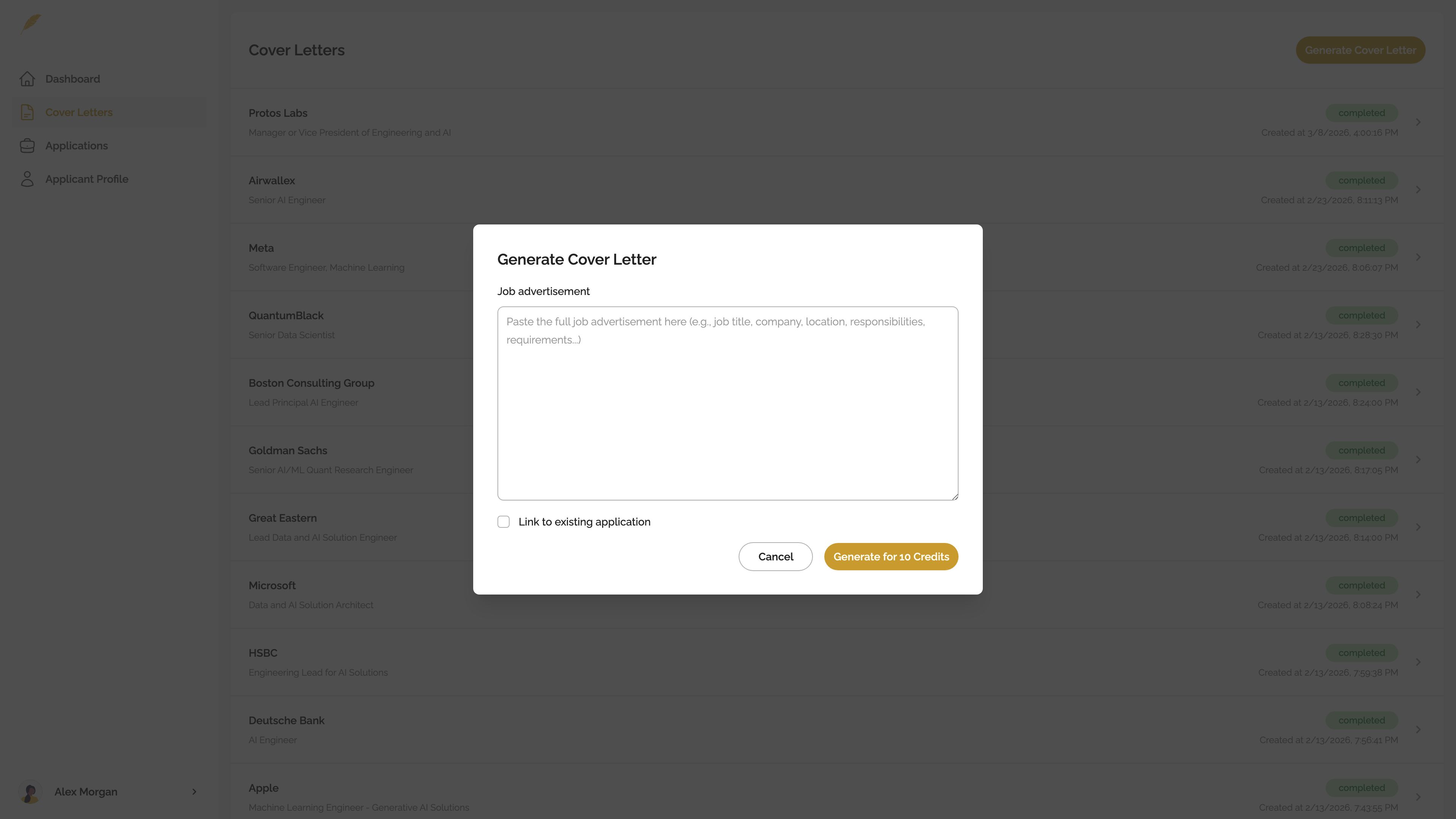
That does not remove your responsibility to review the letter. Genwriter can help reduce generic first drafts by using your profile and the job ad together, but you still need to check truthfulness, edit the voice, and remove unsupported claims.
If you upload a resume or paste personal information into any AI tool, review what you are sharing first. Genwriter's privacy policy explains how the product handles personal data.
Create a tailored draft you can edit before sending
Upload your resume, paste the job ad, and Genwriter will help you create a role-specific cover-letter draft with fit context you can review.
Generate a tailored cover letter from your resume and the job ad
Final Checklist Before Sending An AI-Assisted Cover Letter
Use this checklist even if you skip the full workflow. It catches the problems that make AI cover letters sound generic or risky: wrong names, unsupported claims, copied job-ad language, stiff voice, and privacy oversharing.
Indeed's broad cover-letter mistakes guidance also emphasizes careful proofreading and notes that career advice does not guarantee interviews or offers, which is the right expectation for any final application check (Indeed).
FAQ
Is it okay to use AI to write a cover letter?
Yes, if you supply truthful inputs, review the output, and edit for accuracy and voice. AI is useful for structure, first drafts, phrasing options, and matching a resume to a job ad. It should not decide what is true about your background.
Do not auto-send unreviewed AI output. Remove any invented employer, tool, credential, metric, responsibility, or motivation. The final letter should be something you can explain clearly in an interview.
Can employers tell if I used ChatGPT for my cover letter?
There is no universal answer. Some readers may notice a generic ChatGPT cover letter because it sounds vague, overly polished, copied from the job ad, or weak on evidence. Others may not care whether AI helped if the final letter is accurate and useful.
The practical fix is not detector evasion. The fix is specificity and review. Add real examples, vary the voice, remove unsupported claims, and make sure the letter fits the role.
Should I use an AI humanizer for a cover letter?
An AI humanizer can change surface wording, but it cannot know what is true about you. It may make a generic sentence sound smoother while leaving the same underlying problem: no evidence.
A better workflow is to edit from source facts, job-ad relevance, and proof. Use your resume or profile as the source of truth. Avoid tools or prompts focused on bypassing detection, especially for job applications where accuracy matters.
What phrases make an AI cover letter sound generic?
Common phrases include "passionate," "perfect fit," "fast-paced environment," "strong communicator," and "asset to your team." These phrases are not always forbidden, but they are weak when they stand alone.
The fix is evidence. Instead of saying you are a strong communicator, name the customer handoff, stakeholder update, documentation project, or team process that proves it. Replace broad labels with work the reader can picture.
How much should I rewrite an AI-generated cover letter?
Rewrite the opening, any unsupported claim, one evidence paragraph, and any company-specific line that is vague or false. Those are the parts that most affect whether the letter sounds human.
A usable AI draft may need light editing. A generic draft may need a full rebuild from applicant facts. If the letter could be sent to another employer unchanged, it needs more than a polish pass.
How do I make a cover letter sound more like me?
Use a direct voice you would actually use. Replace formal filler with plain language. Add one or two specific examples from real work. Read the letter aloud and revise anything that sounds unlike you.
Do not force personality into every line. A cover letter can sound human without being casual. Usually, the best voice edit is simple: shorter sentences, fewer abstractions, and one concrete example that only you could write.
What if I do not have metrics for my examples?
Do not invent numbers. Metrics are useful when they are real, but they are not the only form of evidence.
Use concrete scope instead: project type, team, customer segment, workflow, timeline, tools, responsibility, or problem solved. "I coordinated onboarding notes between sales and support for new mid-market accounts" is stronger than "I achieved excellent onboarding outcomes" when you do not have a verified metric.
Can Genwriter make my AI cover letter sound human?
Genwriter can help create a tailored draft from your applicant profile and the job ad, including fit context. That gives the draft better source material than a blank prompt.
You still need to review the final letter, edit the voice, and remove unsupported claims before sending. Start by using Genwriter to generate a tailored cover letter from your resume and the job ad, then apply the evidence and voice checks in this guide.
Make Your AI Cover Letter Sound Human Before You Send It
To make an AI cover letter sound human, do not chase detector tricks. Make it specific, truthful, selective, and written in your voice.
Start with source facts. Replace generic claims with evidence. Rewrite the opening. Add one real job-specific detail. Then audit every important claim before sending.
If you want a faster starting point, use Genwriter to generate a tailored cover letter from your resume and the job ad. Treat the result as a draft you review, not an auto-send button. For a speed-focused companion workflow, read the guide to customize a cover letter quickly.