How to Address Missing Qualifications in a Cover Letter
If you need to address missing qualifications in a cover letter, you probably are not wildly unqualified. More likely, the job description has a long wish list, you match the core work, and one or two requirements make you pause.
The goal is not to make the whole letter about what you lack. First decide whether the gap matters. Then lead with evidence you do have and frame any important partial match honestly. A cover letter should never hide, invent, or inflate experience.
Use this guide to decide whether to apply, whether to mention the missing qualification, and what to write when a gap is obvious enough to address.
To write a cover letter for a job you're underqualified for, first confirm the missing qualification is not mandatory or central to the role. Lead with two or three requirements you can prove, address only a visible and material gap, connect it to truthful adjacent experience, and name a concrete learning step only if it is already underway. Never label yourself “underqualified” or claim a skill or credential you do not have.
How to Write a Cover Letter for a Job You're Underqualified For
1. Decide Whether the Qualification Gap Is Bridgeable
Do not use a universal percentage rule. Missing a preferred tool is not equivalent to missing a license, clearance, regulated credential, or skill the role depends on every day.
Recruiter guidance from Hays notes that job specifications can mix must-have and nice-to-have qualifications. Its practical advice is to determine whether the skills you lack are essential and whether your remaining evidence shows you can do the job—not to count boxes mechanically (Hays).
| Gap type | What it means | Apply? | Cover-letter move |
|---|---|---|---|
| Preferred tool or method | Helpful but not central | Usually | Lead with the related workflow or outcome; do not spotlight the tool gap |
| Fewer years than requested | Your level is close, but the number differs | Maybe | Show scope, ownership, complexity, and impact |
| Missing industry exposure | You know the function, not the domain | Maybe | Name relevant customer, workflow, or regulated-context experience without claiming industry expertise |
| Missing core technical skill | The role is built around a skill you do not have | Usually not | Apply only if the posting makes the skill trainable and your adjacent evidence is strong |
| Missing mandatory credential | Eligibility may depend on a license, clearance, degree, or certification | Usually not | Do not imply you hold it; follow the posting's stated eligibility rules |
Apply when the core responsibilities are within reach and the missing items are preferred, learnable, or peripheral. Be cautious when several central requirements are missing. If a requirement is legal, regulated, safety-critical, contractual, or plainly mandatory, a persuasive sentence cannot make you eligible.
Before deciding, identify the central job-ad requirements, including repeated responsibilities and explicit words such as “required,” “must,” and “preferred.”
2. Map Each Important Requirement to Real Evidence
Classify each important requirement as a strong match when you can prove it directly, a partial match when nearby evidence supports only part of it, a preferred gap when the missing item is optional, or a hard blocker when it is mandatory or central and you cannot meet it.
Use only evidence you can verify in your resume, stored profile, portfolio, projects, coursework, or learning already underway. For every requirement, record the proof, decide whether you should apply, decide whether the point belongs in the letter, and write down any claim the draft must avoid. This prevents a nearby skill from quietly becoming an identical one.
For the full mapping method, use the cover letter fit analysis. The purpose here is simpler: know which claims are safe before you start writing.
3. Lead With Two or Three Strong Matches
Do not open with “Although I do not meet every qualification.” That asks the reader to judge the gap before seeing your fit.
Open with two or three requirements that matter to the role and that you can prove. Useful proof includes scope, an outcome, a tool, a workflow, a stakeholder group, a customer context, or a problem you owned. The National Careers Service recommends keeping a cover letter short, tailoring it to the role, highlighting relevant skills and experience, and supporting statements with facts (National Careers Service).
Instead of:
Although I do not meet every qualification, I believe I could be a good fit for this role.
Use this evidence-led structure:
In my work on [relevant responsibility], I [specific action or scope] using [tool, workflow, or context]. That experience matches your need for [important requirement] and would help me contribute to [role-specific work].
The second version does not claim the gap has disappeared. It simply starts where the evidence is strongest.
4. Mention Only a Gap That Reduces Employer Doubt
Most minor gaps do not belong in the cover letter. If a posting prefers one CRM and you have used another, lead with the customer or operational work—not a confession about software.
Indeed's current guide recommends assessing your qualifications, focusing on demonstrated strengths and achievements, and addressing an important missing area when an employer is likely to notice it (Indeed). Use that test: mention a gap only when a brief, accurate explanation reduces doubt.
| Situation | Mention the gap? | Better move |
|---|---|---|
| You lack one preferred tool but know a related workflow | Usually no | Show the adjacent tool and the result without implying equivalence |
| You have fewer years but comparable ownership | Sometimes | Emphasize scope and responsibility; name the years only if needed |
| A relevant certification is genuinely in progress | Yes, briefly | State its exact status and a reliable completion date, if one exists |
| You lack the central skill the role is built around | Usually no application | Find a bridge role or build the skill first |
| You are changing industries but doing similar work | Sometimes | Explain the transferable workflow while keeping the domains distinct |
Keep the explanation to one or two sentences. Use this sequence:
- Name the exact, material gap.
- Connect truthful adjacent evidence.
- Name a concrete action only if it is already underway and verifiable.
- Return to the contribution you can make.
A safe formula is:
My closest related experience to [missing qualification] is [adjacent evidence]. I have already [verified learning action], which supports my ability to contribute to [relevant responsibility].
Remove the second sentence if no learning action is underway. Never invent enrollment, an exam date, certification status, or a learning plan to make the transition sound smoother.
5. Return the Letter to Contribution and Audit Every Claim
After addressing a gap, bring the letter back to why your verified experience matters for this role. End on relevant value and motivation—not gratitude for being considered despite a shortcoming.
Then compare every sentence with your source material. Check skills, tools, credentials, years, titles, metrics, company details, employment claims, and learning status. Qualify adjacent evidence clearly and remove anything you cannot trace.
Use the complete workflow to tailor the letter to the job description. If application volume is the problem, use the guide to customize a cover letter quickly without reusing an unchecked gap sentence.
Underqualified Cover Letter Example: From Job Ad to Final Draft
Illustrative composite; not a real job ad, applicant record, application, or outcome.
This single composite uses the same evidence at every stage. The illustrative posting asks for customer onboarding ownership, SQL reporting, five or more years in customer success, and a preferred Salesforce administrator certification. The applicant has three years in support operations; led onboarding handoff improvements across sales, support, and customer success; owned a checklist and reporting process managers used to spot delayed follow-ups; partnered with product teams on recurring customer issues; worked in a B2B subscription product; built Tableau dashboards and Excel reports; and has no direct SQL ownership or Salesforce administrator certification.
Requirement-to-Evidence Decision Table
| Requirement | Applicant evidence | Fit level | Apply? | Mention in letter? | Safe wording |
|---|---|---|---|---|---|
| Own customer onboarding projects in a B2B environment | Led onboarding handoff improvements across sales, support, and customer success; owned a checklist and reporting process managers used to spot delayed follow-ups; worked in a B2B subscription product; partnered with product teams on recurring customer issues | Strong | Yes | Yes—lead with it | “I led onboarding handoff improvements across sales, support, and customer success in a B2B subscription-product context.” |
| SQL reporting | Built Tableau dashboards and Excel reports; no direct SQL ownership | Partial | Conditional—only if SQL is not mandatory or role-central | Yes, because it is visible and material | “My reporting work has been in Tableau and Excel rather than direct SQL ownership.” |
| Five or more years in customer success | Three years in support operations plus onboarding ownership | Partial | Yes, if the demonstrated scope fits the level | Sometimes; the final letter states the evidence once | “I bring three years in support operations plus direct ownership of onboarding improvements.” |
| Salesforce administrator certification preferred | No certification | Preferred gap | Yes | No | Omit it; do not imply certification or progress toward it |
| Salesforce administrator certification mandatory for eligibility (hypothetical comparison row) | No certification | Hard blocker | No | Not applicable | Do not apply or imply eligibility; this comparison row is excluded from the final application |
The SQL decision is conditional. If the actual posting makes direct SQL ownership central or mandatory, this example stops at “do not apply.” The cover letter below demonstrates the other case: SQL is material enough to acknowledge, but not a hard eligibility blocker.
AI Overclaim and Corrected Version
An AI draft could turn adjacent reporting work into this unsupported sentence:
I am proficient in SQL and use it to build reporting dashboards that improve customer onboarding.
Corrected version:
I built Tableau dashboards and Excel reports for onboarding work; my reporting work has not included direct SQL ownership.
The correction matters because:
- It names Tableau and Excel, the tools supported by the applicant evidence.
- It keeps SQL visible as a gap instead of converting reporting experience into SQL proficiency.
- It adds no course, learning plan, or expected proficiency date because the evidence establishes none.
This kind of audit requires human judgment. A generated draft can sound plausible while still exceeding its sources.
Complete Composite Cover Letter
Dear Hiring Manager,
I am applying for the [Customer Success Operations Role] at [Employer]. In my support operations work, I have led onboarding handoff improvements across sales, support, and customer success. I owned the checklist and reporting process managers used to spot delayed follow-ups, and I partnered with product teams on recurring customer issues.
I also have experience in a B2B subscription product and have built Tableau dashboards and Excel reports for onboarding work. That combination of customer context, cross-functional process ownership, and reporting experience matches the role's focus on improving onboarding operations.
My reporting work has not included direct SQL ownership. Although the posting asks for five or more years in customer success, I bring three years in support operations plus direct ownership of onboarding improvements.
I would welcome the opportunity to discuss how that experience could support [Employer]'s onboarding work.
Sincerely,
[Applicant Name]
Unsupported-Claim Audit
| Final claim | Source evidence | Status |
|---|---|---|
| Led onboarding handoff improvements across sales, support, and customer success | Applicant evidence records ownership of onboarding handoff improvements across those functions | supported |
| Owned a checklist and reporting process used to spot delayed follow-ups | Applicant evidence records both the process and its use by managers | supported |
| Partnered with product teams on recurring customer issues | Applicant evidence records that collaboration | supported |
| Worked in a B2B subscription product | Applicant evidence records this product context | supported |
| Built Tableau dashboards and Excel reports | Applicant evidence names both tools and reporting work | supported |
| Has no direct SQL ownership | Applicant evidence states this limit explicitly | supported |
| Brings three years in support operations | Applicant evidence records three years | supported |
| Three years are equivalent to the requested five | No evidence establishes equivalence | remove |
| Is proficient in SQL | Tableau and Excel work do not establish SQL proficiency | remove |
| Experience matches the role's onboarding-operations focus | The posting asks for onboarding ownership and reporting; the evidence table supports both, but not every requested qualification | qualified |
| Could support the employer's onboarding work | Prospective contribution grounded in mapped onboarding and reporting evidence, not a claimed outcome | qualified |
There is no interview, response, or hiring outcome attached to this illustrative composite.
How to Handle Common Qualification Gaps
Fewer Years of Experience Than Requested
Years often stand in for a level of responsibility rather than time alone. Do not argue that the number is unimportant. Show the evidence behind the level the employer may be trying to assess:
| Years may signal | Evidence to use |
|---|---|
| Independent ownership | Projects or processes you owned without daily supervision |
| Complexity | Ambiguous problems, cross-team work, or higher-risk workflows |
| Stakeholder maturity | Work with senior stakeholders, customers, vendors, or regulated processes |
| Business impact | Verified effects on revenue, retention, cost, quality, cycle time, or customer experience |
| Progression | Expanded responsibility, promotion, or trusted project ownership |
Use only the rows you can prove. A smaller years gap may be bridgeable when the scope is comparable. A large seniority gap is usually a fit problem, not a wording problem.
Safe framing:
The role asks for [requested years]. I bring [actual years] together with [verified scope, ownership, or impact].
Do not claim “equivalent experience” unless you can explain the equivalence with concrete evidence.
Missing Tool or Industry Experience
Adjacent experience can show a realistic connection, but it is not identical experience. Using Tableau does not prove SQL ownership. Working in regulated fintech does not prove knowledge of healthcare operations. Knowing a related tool can support a workflow claim, not a proficiency claim about the missing tool.
| Safe | Unsafe |
|---|---|
| “I have not used [required tool] in production. My closest related experience is using [adjacent tool] for [same workflow].” | “I am proficient in [required tool]” when the evidence names only an adjacent tool |
The same rule applies to industry changes. Name the transferable customer type, process, risk, or operating constraint. Do not write as though two industries are interchangeable. If the missing domain knowledge is central to daily decisions, reconsider the role rather than stretching the phrasing.
Missing Degree, Certification, License, or Clearance
A preferred degree may sometimes be balanced by directly relevant experience. A mandatory license, certification, or clearance is different: it can define eligibility, not merely preference.
For a preferred education gap, connect your actual evidence to the role:
My background follows a different path from the preferred [degree], and my relevant experience is [specific, verifiable evidence].
State that a credential is in progress only when it is true. Include an exam or completion date only when it is scheduled or otherwise reliable. Never write as if a pending credential has already been awarded.
This is not legal advice. Follow the job posting and the employer's stated eligibility rules. If the requirement is mandatory, regulated, contractual, or safety-critical and you do not meet it, a cover letter cannot solve the gap.
How to Use AI Without Inventing Qualifications
AI can organize evidence, compare a profile with a job ad, and produce a first draft. It can also smooth over a partial match until it sounds like a full qualification.
Use source-only drafting. Provide:
- the job description;
- your resume or verified profile;
- strong matches with their supporting evidence;
- partial matches and missing qualifications;
- learning steps that are already underway;
- a do-not-claim list; and
- the tone you want.
Add this constraint:
Use only the resume or profile and job description below. Classify each important requirement as a strong match, partial match, gap, or blocker before drafting. Do not turn adjacent experience into identical experience. Do not claim a skill, credential, metric, title, employer fact, or learning step that the sources do not establish.
For a fuller source-constrained workflow, use the ChatGPT cover letter prompt for a resume and job description.
Then review the output line by line. Compare every claim with its source, qualify partial matches, and remove plausible-sounding additions. No prompt or product removes the applicant's responsibility for the final letter.
Before uploading a resume, job history, or personal details, share only what the task requires and review how the service handles your data.
Use Genwriter to Compare the Job Ad With Your Profile
Genwriter supports the same evidence-first workflow. You create a stored applicant profile from your resume and supporting documents, paste a job ad, and run a fit analysis that organizes strengths, weaknesses, and framing guidance. The app can then generate a cover-letter draft from that profile and job-ad context.
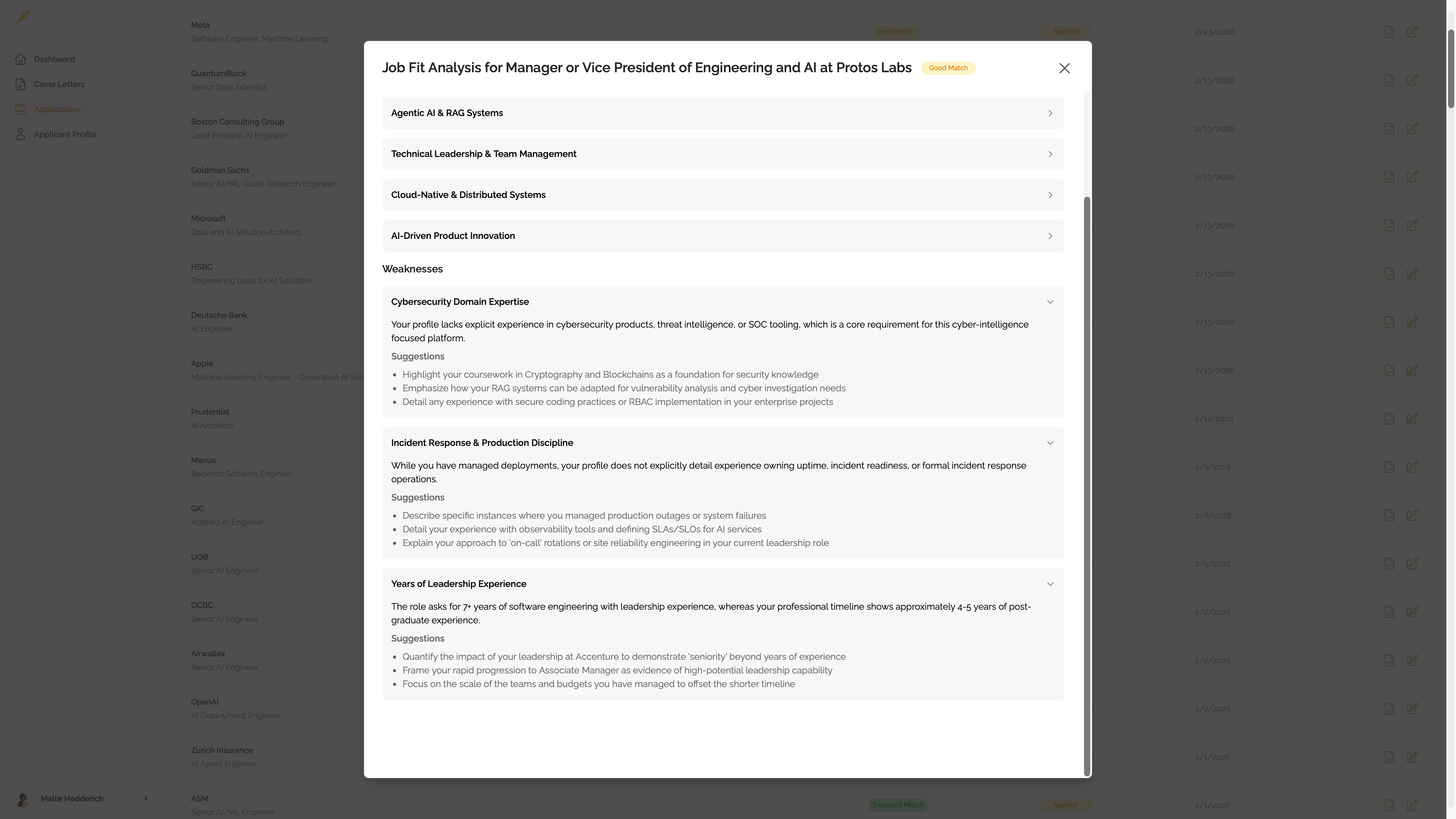
The screenshot shows the product interface, not an application result. A fit analysis does not make an applicant qualified, verify every statement, or replace review. Its value is the structured comparison: the draft starts with a stored profile and a specific job ad instead of context assembled from memory.
Before submitting, the applicant still needs to compare the generated letter with the profile and posting, correct any overstated relationship, and remove unsupported claims.
Generate a tailored cover letter from your resume and the job ad
Final Checklist Before Sending
Use this as a binary check:
If any box remains unchecked, revise or remove the claim before sending.
FAQ
Should I say I am underqualified in a cover letter?
No. Do not give yourself a negative label before the reader sees your evidence. If a meaningful gap needs explanation, name that specific qualification briefly, connect it to truthful adjacent experience, and return to what you can contribute. Write “My closest related experience is…” rather than “I know I am underqualified.”
Is it okay to apply if I do not meet all the job requirements?
Sometimes. Apply when the core responsibilities are within reach and the gaps are preferred, learnable, or peripheral. Reconsider when you lack several central requirements. Do not imply you meet a mandatory, legal, regulated, safety-critical, or contractual requirement when you do not.
What should I write if I lack the requested years of experience?
State your actual experience and show the scope behind it: ownership, complexity, stakeholders, impact, or progression. Do not argue with the requested number or claim equivalence without proof. If the seniority gap is large, treat it as a role-fit question rather than a cover-letter wording problem.
Can transferable skills compensate for a missing qualification?
They can support a partial match when the missing item is a preferred tool, method, domain, or proxy for experience. They cannot replace a mandatory credential or a skill central to the job. Name precisely what transfers and keep the missing qualification distinct.
What if the job description says a requirement is mandatory?
Treat it as a potential blocker. Check the posting's exact eligibility language and any allowance for equivalent or in-progress qualifications. If you do not meet a mandatory requirement and the employer provides no accepted alternative, do not imply that you do. A cover letter cannot override eligibility rules.
Address the Gap, Then Bring the Letter Back to Fit
A partial-fit cover letter should spend most of its space on truthful fit. First decide whether the role is realistic. Then map requirements to evidence, lead with the strongest matches, address only a material gap, and audit every final claim. Honest adjacent experience can clarify your value; it should never be used to make a missing qualification look complete.