Cover Letter Keywords List: What to Use, Rephrase, or Skip
Use this cover letter keywords list as a set of job-ad signal categories, not a word bank to paste into every application. Start with the employer's tools, hard skills, responsibilities, outcomes, credentials, and work context; then keep only the terms your resume, profile, portfolio, or projects can support.
Use exact wording when it is true, rephrase a partial match, and skip an unsupported keyword. The categorized list comes first; the method below shows how each selected term becomes a natural cover-letter sentence.
Cover Letter Keywords List by Category
Every entry below is an example to check against your own job ad. None is a universal “best” keyword.
| Category | Scannable examples | Selection rule |
|---|---|---|
| Tools and hard skills | Python, Salesforce, HubSpot, data analysis, financial modeling |
Use the job ad's exact term only when the applicant has matching evidence. |
| Responsibilities | customer onboarding, project management, stakeholder reporting, lifecycle campaigns, product launches |
Prefer central or repeated work the applicant has actually done. |
| Outcomes | activation, retention, cost reduction, conversion, delivery speed |
Connect the term to a real result or explain its relevance without inventing a metric. |
| Credentials and methodologies | CPA, PMP, Agile, security clearance |
State credentials exactly and only when held; do not soften a missing regulated requirement into a claim. |
| Work context | B2B SaaS, customer-facing, cross-functional collaboration, regulated environment, early-stage startup |
Include context only when a concrete role or project supports it. |
| Evidence-backed action language | built, launched, analyzed, automated, led, improved |
Use the verb only when it accurately describes the applicant's action and scope. |
The job description supplies the relevant terms; this list supplies categories for finding them.
How to Choose: Use, Rephrase, or Skip
A keyword belongs in your cover letter only when it matters to the role and you can connect it to evidence.
- Use the term when your evidence matches it directly. Exact wording is useful for tools, credentials, methodologies, and established role language.
- Rephrase it when your experience is relevant but narrower, adjacent, or less extensive than the job ad suggests.
- Skip it when using the term would create an unsupported claim.
Evidence can come from a resume, profile, portfolio, project note, credential, or specific work example. The Balance similarly recommends tying keywords to a role or project rather than listing them without context (The Balance).
If you are unsure whether a signal is a strength, a partial match, or a genuine gap, start with a cover letter fit analysis before drafting.
Illustrative composite; not a real job ad, applicant profile, or outcome.
| Job-ad phrase | Composite applicant evidence | Decision | Final-sentence treatment |
|---|---|---|---|
Own onboarding and activation campaigns |
Rebuilt a trial-onboarding email sequence in a B2B SaaS role | Use | Use onboarding and activation as the central responsibility and outcome language. |
HubSpot and Customer.io |
Used HubSpot regularly; ran one segmented test in Customer.io | Rephrase | Name both tools while explicitly limiting the Customer.io claim to one test. |
Partner with product and customer success |
Worked with both teams on launch messaging | Use | Tie the collaboration term to that specific project. |
Cybersecurity experience preferred |
No direct cybersecurity evidence | Skip | Omit the term; do not substitute enthusiasm or imply adjacent expertise. |
Final composite sentence:
In my last B2B SaaS role, I rebuilt a HubSpot trial-onboarding sequence, ran one segmented test in Customer.io, and partnered with product and customer success to align launch messaging with trial-user questions.
In that sentence, onboarding, HubSpot, and collaboration are used; Customer.io depth is rephrased accurately; cybersecurity is skipped; no performance metric is invented.
What Are Keywords in a Job Description?
Job-description keywords are the words and phrases that name the role's important skills, tools, responsibilities, outcomes, credentials, methodologies, and work context. Indeed describes cover-letter keywords as terms connected to the qualifications an employer is looking for (Indeed).
A keyword is a signal to evaluate, not an automatic instruction to copy. Python, customer onboarding, or CPA may be important to the employer, but the term belongs in your application only when it accurately describes your background.
Should Resumes and Cover Letters Use the Same Keywords?
Your resume and cover letter should use consistent wording for the same true skills, tools, credentials, and responsibilities. If your resume says Salesforce, the cover letter should not rename it vaguely as “a CRM platform.” If you hold a PMP, state the credential the same way in both documents.
The documents use those terms differently:
| Keyword type | Resume use | Cover-letter use |
|---|---|---|
| Tool or platform | Skills section or relevant experience bullet | Name it inside a project, action, or responsibility |
| Responsibility | Experience bullet | Explain how similar work prepares you for this role |
| Outcome | Achievement or result | Connect the outcome to the employer's need |
| Soft skill | Evidence-backed experience bullet | Show it through a concrete situation |
| Credential | Education or certification section | Mention it when it is central to the role |
A resume can contain a broader inventory of relevant terms. A short cover letter should use fewer keywords and place them inside an evidence-based argument for fit.
How to Identify Keywords in a Job Description
To identify keywords in a job description, read for the terms that define the work rather than starting with the employer's branding language.
Look in:
- The job title and seniority level.
- Core responsibilities.
- Required and preferred qualifications.
- Named tools, systems, credentials, and methodologies.
- Repeated phrases.
- Outcomes the person is expected to influence.
- Team, customer, product, domain, or company context.
Wonsulting recommends decoding the job description for hard skills, soft skills, and the central problem behind the role (Wonsulting). Repetition can indicate importance, but it does not make a term safe to claim. Evidence still decides whether you use, rephrase, or skip it.
A practical extraction workflow is:
- Highlight phrases that describe concrete work, requirements, tools, outcomes, or context.
- Group each phrase by category.
- Mark whether it appears to be required, repeated, preferred, or background context.
- Find resume, profile, portfolio, credential, or project evidence for each phrase.
- Apply the
Use,Rephrase, orSkipdecision. - Keep the few terms that best represent both the role and your real fit.
If you are asking how to find keywords in a job description quickly, focus first on repeated responsibilities, explicit requirements, named tools, and outcomes. Generic adjectives such as dynamic, passionate, or hard-working are usually less useful unless the posting defines what they mean through concrete behavior.
How to Use Keywords Naturally
Keywords should sit inside evidence rather than float in a list. A useful sentence often follows this structure:
In [context], I [evidence-backed action using the relevant term], which [result or relevance to the role].
The three main placement options are:
| Cover-letter part | Keyword role | Good use | Bad use |
|---|---|---|---|
| Opening | Establish relevance | Name one central job signal with immediate proof | List several terms before giving evidence |
| Body | Demonstrate fit | Connect a few related keywords to a project or responsibility | Restate the job ad in paragraph form |
| Closing | Reinforce focus | Refer to the role's central problem or contribution | Add another list of buzzwords |
Do not force the exact phrase into every paragraph. Use it where it makes the evidence clearer, then write normally.
Natural Versus Stuffed Keyword Use
Using the same illustrative terms from the composite above, a stuffed sentence would read:
I am a cross-functional B2B SaaS professional with onboarding, activation, HubSpot, Customer.io, cybersecurity, launch messaging, and strong collaboration skills.
It compresses a list into a sentence, overstates the evidence, and includes the unsupported cybersecurity term. The final composite sentence above is the natural rewrite: it connects the supported terms to actions, limits the Customer.io claim, and leaves the unsupported keyword out.
A sentence is probably stuffed when it:
- Packs several phrases together without explaining what the applicant did.
- Repeats the same term solely for density.
- Copies the job description's syntax.
- Uses a credential, tool, or domain term without evidence.
- Sounds less natural after the keywords are added.
If an AI-assisted draft still sounds stuffed after the evidence is fixed, use the guide on how to make an AI cover letter sound human for the voice edit.
What to Skip or Rephrase
Skip any keyword that would create a false claim about a tool, certification, degree, language, security clearance, regulated credential, responsibility, or domain.
Rephrase a partial match only when the revised wording remains specific and useful. For example:
| Job-ad signal | Honest treatment |
|---|---|
| Deep experience with a tool used once | State the limited use or lead with a better-supported adjacent tool |
| Ownership of a responsibility you only supported | Describe your contribution without claiming ownership |
| Outcome without a measured result | Explain the work's relevance without inventing a number |
| Preferred domain experience you lack | Omit it or name genuinely adjacent experience without implying equivalence |
| Required credential you do not hold | Do not claim, soften, or approximate the credential |
| Generic soft skill | Replace it with a situation that demonstrates the behavior |
What if you cannot truthfully claim an important keyword? Do not insert it for relevance. If the requirement is partial, explain the adjacent evidence accurately. If it is a central gap, decide whether the rest of your fit justifies applying and address the gap only when doing so helps the reader understand your candidacy. The guide to addressing missing qualifications in a cover letter covers that decision in more depth.
Also avoid keyword lists, copied company values, “perfect fit” language, and generic traits such as self-motivated, detail-oriented, or team player unless a concrete example gives them meaning.
Do Cover Letter Keywords Help With ATS?
Some employers use applicant tracking systems or document search as part of their hiring workflow. A cover letter may be parsed, searched, or read, but implementations differ, and no keyword tactic guarantees passage, ranking, an interview, or a hiring outcome.
When someone says a cover letter may be “searched for keywords,” it means relevant text in the uploaded document may be searchable or comparable with role language. It does not mean every system scores cover letters the same way or that repeating a phrase improves the application.
Use ATS-related guidance as a relevance and formatting check:
- Follow the requested file format.
- Keep uploaded cover-letter formatting simple.
- Use normal job language for skills, tools, credentials, and responsibilities that are true.
- Keep claims consistent with the resume.
- Avoid images, unusual columns, and decorative layouts in the uploaded letter.
- Prioritize accuracy and readability over keyword density.
The resume is generally the more structured record of skills, credentials, tools, and work history. The cover letter's job is to explain why selected evidence matters for this role. A cover letter cannot repair unsupported claims or a resume that omits a central qualification the applicant actually has.
Manual and AI-Assisted Workflow
You can complete the process manually:
- Extract the role's central phrases.
- Classify them as skills, tools, responsibilities, outcomes, credentials, soft skills, or context.
- Separate requirements and repeated signals from minor preferences.
- Match every candidate term to evidence.
- Mark each one
Use,Rephrase, orSkip. - Draft an opening and body paragraph around the strongest supported terms.
- Audit the letter for inaccurate claims, stuffing, and inconsistent wording.
The UGA Career Center's tailored-cover-letter T-chart uses a related matching method: pull requirements and phrases from the job description, then map your qualifications to them (UGA Career Center).
This keyword pass is one part of the broader process. The full guide to tailoring a cover letter to a job description covers prioritization, company context, evidence selection, drafting, and review.
AI can speed up classification and comparison, but it should not decide what is true. Coursera's ChatGPT cover-letter guidance notes that AI can help identify keywords and incorporate resume skills while still requiring careful review for accuracy and authentic voice (Coursera).
Use a prompt that separates extraction from fact-checking:
Review this job description and classify the most important cover-letter keywords by type: skill, tool, responsibility, outcome, credential, soft skill, and company context. Then compare them with my resume/profile evidence below. Mark each keyword as Use, Rephrase, or Skip. Do not invent experience, metrics, tools, credentials, company research, or qualifications I have not provided.

Job description:
[paste job description]

Resume/profile evidence:
[paste relevant evidence]
Before sending any manually or AI-assisted draft, check:
Ready to apply the list to your own role? Generate a tailored cover letter from your resume and the job ad, then check every keyword against your real evidence.
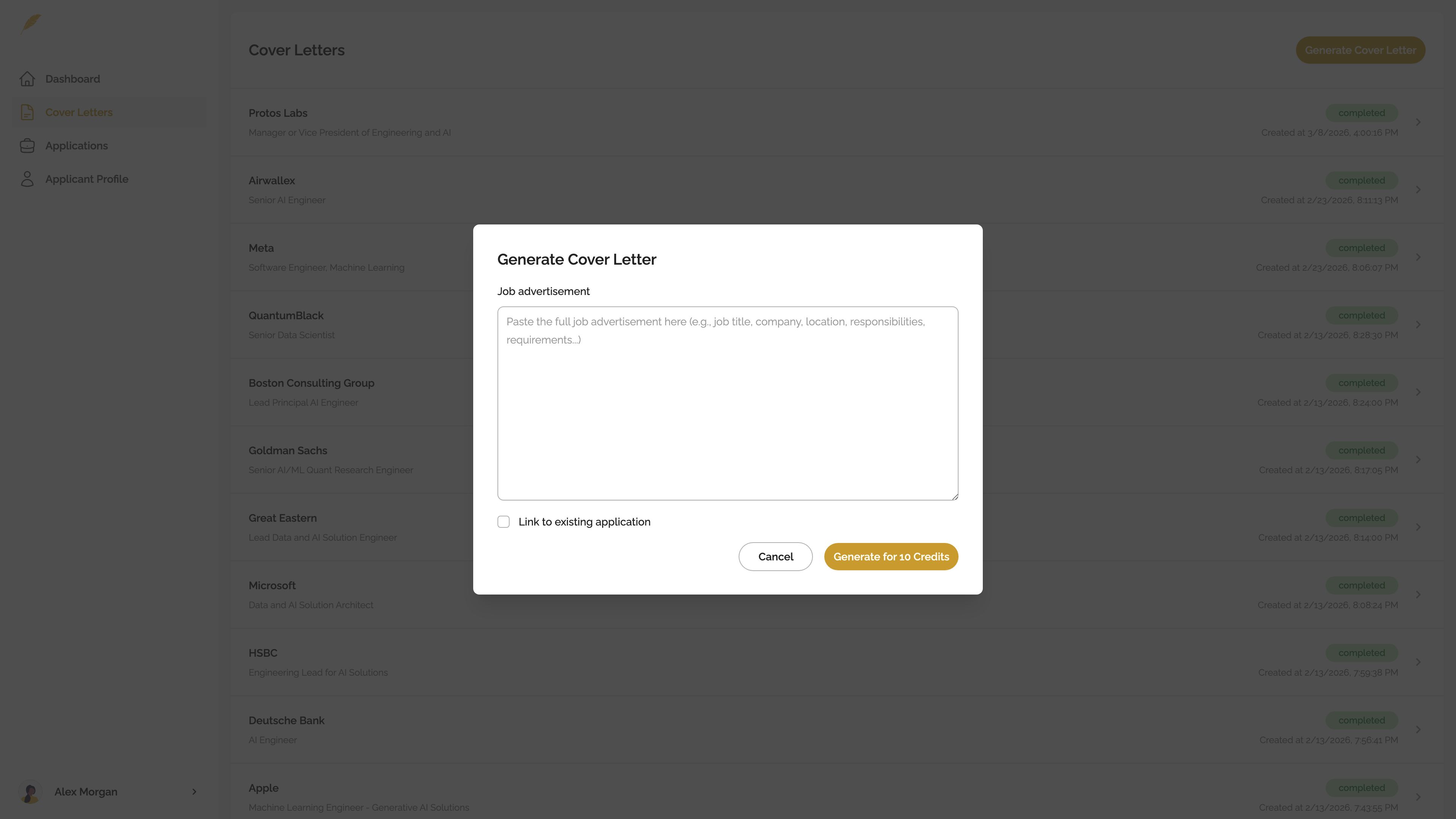
Genwriter uses profile and job-ad inputs in the drafting workflow, but the applicant still needs to review every keyword, partial match, and claim before sending the letter.
FAQ
How many keywords should I use in a cover letter?
There is no required quota. For a short cover letter, 2-4 central, supportable job-description terms are a practical check, not a universal rule. A smaller number tied to strong evidence is more useful than a longer list.
Should I copy exact keywords from the job description?
Use exact wording for true tools, credentials, methodologies, job titles, and established role terms. Rephrase when the wording would exaggerate your experience, and never copy full job-ad sentences into the letter.
Should my resume and cover letter use the same keywords?
They should use consistent terms for the same true skills, tools, credentials, and responsibilities. The resume can contain a broader, structured set of terms; the cover letter should select fewer and explain them through evidence.
What if I cannot truthfully claim an important keyword?
Do not claim it. Rephrase a partial match with accurate adjacent evidence, or skip an unsupported term. If the gap is central to the role, consider whether and how to address the missing qualification instead of forcing the keyword into the letter.
Do ATS systems scan or search cover letters?
Some hiring workflows may parse or search uploaded cover letters, while others may treat the resume as the main structured document. Use relevant language naturally and keep formatting simple, but do not assume a keyword count, density, or phrase can guarantee screening success.
Conclusion: Use Keywords to Show Real Fit
The useful keywords for a cover letter come from the job description and connect to evidence the applicant can support. Use exact terms when they are true, rephrase partial matches accurately, and skip unsupported language.
That approach gives both documents a consistent story without turning the cover letter into a keyword list or an ATS tactic.