Tailored vs Generic Cover Letters: Examples That Show the Difference
If you searched for a tailored vs generic cover letter example, you probably know the advice already: tailor the letter. The harder part is seeing what actually changes.
This guide shows the difference with side-by-side examples. You will see generic paragraphs, why they feel weak, tailored rewrites, and the decision path from job-ad signal to applicant evidence.
The ethical boundary matters: tailoring does not mean pretending to match a job. It means choosing true, relevant evidence and leaving unsupported claims out. The examples below are illustrative composites based on common cover-letter patterns. They are not real applicants, employers, user data, recruiter feedback, or hiring outcomes.
A generic cover letter can be sent to almost any employer because it relies on broad claims like "I am a strong communicator." A tailored cover letter is specific to one job because it connects the role's requirements to true evidence from the applicant's resume, projects, tools, metrics, or domain experience.
- Generic: broad enthusiasm, reusable skills, little evidence.
- General/adaptable: stable structure, but modified for each role.
- Tailored: job-ad signal plus applicant evidence plus honest fit framing.
- Weak signal: only the company name changed.
- Strong signal: the paragraph would stop making sense if sent to another job.
Generic vs General vs Tailored Cover Letters
A generic cover letter is unchanged or barely changed across applications. It usually has broad enthusiasm, reusable soft skills, little job-specific evidence, and edits limited to the employer name, role title, or greeting.
A general/adaptable cover letter is different. It uses a stable structure, but the final version is intentionally modified for the job. Resume.co makes this useful distinction: a general letter can be adapted, while a generic letter stays essentially the same across roles (Resume.co).
A tailored cover letter is built around this job's important requirements. It selects true applicant evidence, explains fit without repeating the whole resume, and would not make equal sense for five unrelated roles. UC Berkeley Law makes a similar targeted-versus-mass-mailer distinction in its legal-career guidance, noting that targeted letters are individually shaped by employer research while mass mailers are generic except for basic employer details (UC Berkeley Law).
| Type | What changes between applications? | What it sounds like | Risk |
|---|---|---|---|
| Generic | Almost nothing except company or role name. | Broad enthusiasm and unsupported skills. | Feels interchangeable and low-effort. |
| General/adaptable | Structure stays stable, evidence and emphasis change. | Reusable frame with job-specific proof. | Can still be weak if edits are superficial. |
| Tailored | Job-ad signals determine which proof appears. | Specific evidence tied to the role. | Takes more judgment; must avoid overclaiming. |
A company-published ResumeGo research page reported stronger outcomes and stated preferences for tailored letters in a 2019-2020 field experiment and a survey of hiring professionals. Treat that as directional, not definitive proof, because ResumeGo sells resume-writing services and the data is older (ResumeGo).
The Fast Test: Could This Letter Go To Any Employer?
Generic language is not one forbidden phrase. It is a fit problem.
If the paragraph still works after replacing the company and role name, it is probably generic. If the paragraph depends on the job's actual responsibilities and the applicant's real evidence, it is probably tailored.
A tailored letter is not necessarily longer. Often it is shorter because it removes filler: broad excitement, repeated soft skills, fake company praise, and unsupported claims.
Use this before reviewing the examples:
The goal is not to cram more details into every paragraph. The goal is to make the right details visible.
Example 1: Generic Enthusiasm vs Evidence From The Job Ad
Composite example for illustration.
Scenario: a product analyst role at a B2B SaaS company. The employer wants someone who can analyze onboarding behavior, work with product managers, and explain findings clearly.
Job-Ad Signals And Applicant Evidence
| Job-ad signal | Applicant evidence | Use in tailored version? | Reason |
|---|---|---|---|
| Analyze onboarding funnel drop-off. | Built SQL cohorts for trial-to-paid activation in an edtech SaaS role. | Yes | Core responsibility with direct evidence. |
| Create dashboards for product and customer teams. | Built a weekly Looker dashboard used by PM and customer success. | Yes | Shows tool, audience, and workflow. |
| Partner with cross-functional teams. | Worked with PM, lifecycle marketing, and CS on activation reporting. | Yes | Supports collaboration claim. |
| Payments or billing domain experience. | No direct payments experience. | No | Unsupported and not needed for the strongest paragraph. |
| Present insights to executives. | Presented monthly trends to a director, not executives. | Maybe | Could be framed carefully, but not necessary here. |
Generic Paragraph
Generic version:
I am excited to apply for the Product Analyst role because my background in analytics, communication, and problem-solving aligns well with your needs. I have experience working with data and collaborating with teams to improve business outcomes. I am impressed by your company's innovative approach and would welcome the chance to contribute my skills in a fast-paced environment. I believe my attention to detail and passion for data would make me a strong addition to your team.
Why The Generic Version Is Weak
| Generic sentence or phrase | What is weak | Better decision |
|---|---|---|
| "my background in analytics, communication, and problem-solving" | Lists broad traits without proof. | Use the onboarding cohort work. |
| "aligns well with your needs" | Says fit exists but does not show what need is being met. | Name the onboarding funnel responsibility. |
| "experience working with data" | Too broad for an analyst role. | Mention SQL cohorts and Looker dashboard work. |
| "innovative approach" | Company praise with no verified detail. | Skip praise unless there is a checked public source. |
| "fast-paced environment" | Reusable filler. | Use cross-functional product and CS context. |
Tailored Paragraph
Tailored version:
In my current product operations role, I built SQL cohort analyses to understand where trial users dropped out before activation, then turned the findings into a Looker dashboard used by product managers and customer success. That experience matches the role's focus on onboarding funnel analysis and cross-functional decision support. I have not worked directly in payments, so I would not position that as a strength. The stronger overlap is using behavioral data to identify friction, explain it clearly to product partners, and help teams decide which onboarding changes to test next.
What Changed And Why It Works
| Decision | Generic version | Tailored version |
|---|---|---|
| Role signal | Not named. | Names onboarding funnel analysis and cross-functional support. |
| Evidence | Broad skill claim. | Uses SQL cohorts, Looker dashboard, and product/CS audience. |
| Company context | Vague praise. | Skips company praise because no verified detail was supplied. |
| Claim safety | Implies broad fit. | Names a missing payments-domain signal and stays with proven evidence. |
This tailored paragraph would not work unchanged for a brand marketing role, an HR generalist role, or a finance role. That is the point. It depends on this job's work and this applicant's evidence.
Example 2: Keyword Stuffing vs Natural Job-Specific Language
Composite example for illustration.
Tailoring is not copying the job description. Exact terms can help when they are true and natural, but unsupported repetition reads like keyword stuffing. For the deeper keyword workflow, use this guide to cover letter keywords from a job description.
Generic Paragraph With Keywords But No Proof
Generic version:
My experience includes marketing automation, lifecycle campaigns, CRM management, segmentation, attribution reporting, SQL, stakeholder management, and campaign optimization. I am confident these skills align with your Marketing Operations Specialist role. I am highly organized, data-driven, and comfortable working across teams to deliver measurable results in a fast-paced environment.
This paragraph includes role language, but it does not prove any of it. The reader cannot tell which tools were used, what campaigns were managed, who depended on the work, or what changed because of it.
Tailored Paragraph With Fewer, Stronger Signals
Tailored version:
The strongest match is lifecycle campaign operations. In my last role, I rebuilt three HubSpot nurture sequences for trial users, segmented audiences by activation stage, and coordinated weekly performance reviews with sales and customer success. I also maintained a campaign dashboard that showed email engagement, demo requests, and handoff status by segment. I have used SQL for list checks and QA, but I would frame that as support experience rather than a core analytics strength.
| Job-ad phrase | Generic use | Tailored use |
|---|---|---|
| Marketing automation | Repeated without proof. | Connected to rebuilding HubSpot nurture sequences. |
| Segmentation | Listed as a keyword. | Tied to activation-stage audiences. |
| Stakeholder management | Claimed broadly. | Shown through sales and customer success reviews. |
| SQL | Implies full strength. | Framed as list checks and QA support. |
The tailored version uses fewer keywords, but each one has evidence behind it.
Example 3: Partial Match vs Overclaiming
Composite example for illustration.
This is where tailoring earns trust. A tailored cover letter should not pretend the applicant is perfect. It should lead with real strengths and handle partial matches carefully. For a fuller gap-framing workflow, read how to address missing qualifications in a cover letter.
Scenario: a customer success manager role asks for Salesforce experience, enterprise renewal support, onboarding playbooks, and customer escalation handling. The applicant has strong customer success experience, but mostly in HubSpot and Zendesk, not Salesforce.
Generic Paragraph That Sounds Confident But Risky
Generic risky version:
My experience perfectly aligns with your Customer Success Manager requirements, and I meet all of your needs across CRM management, renewals, onboarding, and customer escalations. I am confident I can immediately handle your Salesforce workflows and enterprise customer base. My communication skills, customer-first mindset, and ability to manage complex relationships make me an ideal fit for this position.
The problem is not confidence. The problem is unsupported certainty. "Perfectly aligns," "meet all," and "immediately handle your Salesforce workflows" go beyond the applicant's evidence.
Tailored Paragraph That Frames The Partial Match Honestly
Tailored version:
The strongest overlap is customer onboarding and escalation work. In my current CS role, I manage onboarding for 25-30 SMB accounts per quarter, maintain Zendesk escalation notes, and helped rewrite the handoff playbook between sales and customer success. I have not used Salesforce directly, but I have worked in HubSpot-based CRM workflows and can bring a practical foundation in pipeline notes, renewal reminders, and customer-health tracking. I would frame my fit around onboarding discipline and escalation follow-through, not direct Salesforce ownership.
| Requirement | Actual evidence | Unsafe wording | Safer tailored wording |
|---|---|---|---|
| Salesforce experience | HubSpot CRM workflows, Zendesk escalation records | "I can immediately handle your Salesforce workflows." | "I have not used Salesforce directly, but I have related CRM workflow experience in HubSpot." |
| Enterprise renewals | SMB onboarding and renewal reminders | "I meet all enterprise renewal requirements." | "My renewal experience is SMB-focused, with adjacent work in health tracking and reminders." |
| Customer escalation handling | Maintained Zendesk notes and follow-up process | "I am an expert in complex escalations." | "I have handled escalation follow-through and documentation in Zendesk." |
| Onboarding playbooks | Rewrote sales-to-CS handoff playbook | "I can own every onboarding program immediately." | "I have helped improve onboarding handoffs and playbook clarity." |
A partial-match paragraph can still be strong. It just needs to be precise.
Example 4: Fake Company Personalization vs Useful Specificity
Composite example for illustration.
Fake personalization often sounds more tailored than it is. It praises the company's mission, culture, innovation, or recent growth without proving that the applicant understands the role.
Do not invent company facts, recent news, hiring-manager names, product details, or motivations. If you include a company-specific detail, verify it from a public source first. If you cannot verify it, use role-specific evidence instead.
| Generic personalization | Why it fails | Useful tailored alternative |
|---|---|---|
| "Your commitment to innovation inspires me." | Could apply to almost any company and gives no proof. | "The role's focus on reducing onboarding friction matches my work improving support-to-CS handoffs." |
| "I admire your award-winning culture." | Unsupported unless a real source is cited. | "The cross-functional nature of the role fits my experience working with PM, sales, and CS." |
| "Your mission deeply aligns with my values." | Vague and hard to verify. | "The job's customer education responsibility matches the help-center redesign I led." |
| "I have followed your company for years." | Risky if not true and specific. | "I am most interested in the role because it combines lifecycle reporting with customer activation work." |
Specificity does not always mean company praise. Often the better move is to connect a real role responsibility to real applicant evidence.
A Tailored Cover Letter Is Selective, Not Just Longer
Generic letters often become long because they try to cover every possible strength. Tailored letters are selective. They choose 2-3 job-ad signals, connect them to proof, cut filler, and skip unsupported requirements.
Coursera's cover-letter guidance makes a similar point: use the job description to identify the skills most necessary for the role, then show how you have used those skills before rather than listing everything (Coursera).
If you need help deciding which evidence belongs in the letter, first match your resume to a job description. Then write from the strongest overlap.
| Candidate detail | Include in tailored cover letter? | Why |
|---|---|---|
| Strong match to core job responsibility | Yes | Helps reader see fit quickly. |
| Repeated keyword with real evidence | Yes, naturally | Supports relevance without stuffing. |
| Nice-to-have with no evidence | Usually no | Weakens trust or invites overclaiming. |
| Generic soft skill | Only with proof | Needs a project, outcome, or context. |
| Long resume task list | No | Belongs in the resume, not the letter. |
The best tailored paragraph may have fewer words than the generic one. It just has better evidence density.
How To Turn Your Own Generic Paragraph Into A Tailored One
Use this as a paragraph rewrite exercise, not a full cover-letter workflow.
First, highlight generic claims. Then pick 2-3 job-ad signals. Match each signal to true evidence from your resume, profile, project notes, or portfolio. Replace vague claims with evidence. Cut unsupported fit statements. Run the "could this go to any employer?" test.
For the full letter-level process, use the guide to tailor a cover letter to a job description. If you are applying at volume, use the shorter workflow to customize a cover letter quickly.
Rewrite Template
Generic claim:
[I am a strong fit because...]

Job-ad signal:
[The role asks for...]

Applicant evidence:
[My resume/profile shows...]

Tailored sentence:
[In/At/While working on..., I..., which matches the role's need for...]

Claim-safety check:
[This sentence is supported by... / This sentence needs revision because...]
This template is a drafting aid, not final copy. The final sentence should sound like you and stay within what you can prove.
Mini Before-And-After Pattern
Composite examples for illustration.
| Generic sentence | Tailored sentence pattern |
|---|---|
| "I am a strong communicator." | "In [context], I translated [technical/customer/process detail] for [audience], which fits the role's need for [job-ad signal]." |
| "I am passionate about your mission." | "The role's focus on [specific work] matches my experience with [specific evidence]." |
| "My skills align well with the position." | "The clearest overlap is [skill/responsibility], where I have [proof]." |
| "I thrive in fast-paced environments." | "During [project or cycle], I managed [scope] while coordinating with [teams]." |
| "I have leadership experience." | "I led [initiative] for [group or workflow], resulting in [outcome if true]." |
What Generic AI Cover Letters Usually Get Wrong
AI can help with cover letters, but it can also produce generic drafts when the source material is thin or the prompt is broad. The issue is not that AI helped. The issue is that the draft has too little verified applicant evidence and too many polished guesses.
For safer prompting, use a ChatGPT cover letter prompt for a resume and job description. For editing the final voice, use the guide to make an AI cover letter sound human.
| Generic AI issue | Why it happens | Safer fix |
|---|---|---|
| Broad enthusiasm with no proof | The tool has too little applicant evidence. | Add resume/profile facts before drafting. |
| Job-ad language repeated back | The prompt asks for tailoring but not evidence. | Match each key requirement to proof first. |
| Overconfident fit language | The tool optimizes for persuasive copy. | Add a rule to flag gaps and avoid invented claims. |
| Fake company personalization | The prompt asks for personalization without verified sources. | Use only public, checked company facts or skip praise. |
Structured profile-to-job-ad inputs reduce the risk, but they do not remove the need for review. Check every tool, credential, metric, company fact, and motivation before sending. When using any AI tool, also review what personal data you submit.
Where Genwriter Fits In The Difference
Generic letters usually come from weak inputs: a job title, a thin resume, and a request to sound professional. Tailored letters come from better decisions: what the role asks for, what the applicant can prove, what to skip, and how to frame partial matches.
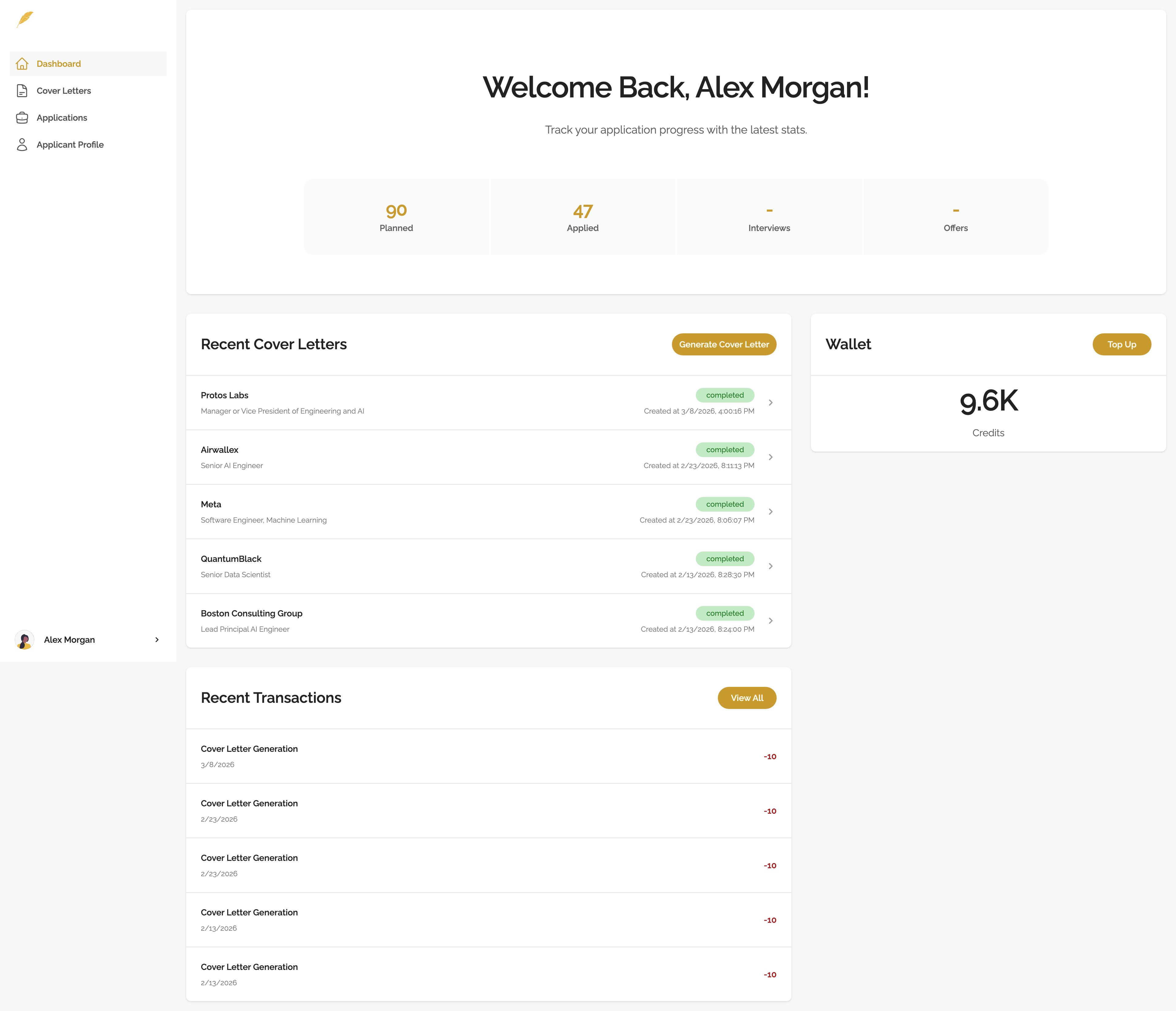
Genwriter is built around that decision step. You start from your resume or profile, add the job ad, compare fit, identify strengths and gaps, and produce a tailored draft to review. The point is not auto-sending. The point is starting from structured evidence instead of a blank page or a generic prompt.
Genwriter does not make you qualified for a role you are not qualified for, and it should not be treated as a truth-verification system. You still need to check the final letter for accuracy, voice, missing context, and claims that go beyond your evidence. For Genwriter-specific data handling, read the privacy policy.
Create a tailored draft from real inputs
Genwriter helps you start with your resume or profile, compare it with the job ad, and draft a cover letter you can review for evidence, gaps, and voice before sending.
Generate a tailored cover letter from your resume and the job ad
FAQ
What is the difference between a generic and tailored cover letter?
Generic cover letters rely on broad claims and can be sent to many employers unchanged. Tailored cover letters connect this job's requirements to true applicant evidence. These tailored vs generic cover letter examples show the practical difference: a generic paragraph says "I am a strong communicator," while a tailored one shows where communication mattered, who it helped, and why it fits the role.
Is a general cover letter the same as a generic cover letter?
No. A general or adaptable base letter can be useful if you modify it for each role. A generic final letter is weak because it stays interchangeable. Resume.co makes the same broad distinction between a flexible general letter that can be adapted and a generic letter that remains mostly unchanged. The risk is sending the base version as the final version.
How can I tell if my cover letter is too generic?
Use the "could this go to any employer?" test. Replace the company name and role title. If the paragraph still works for a different job, it is probably too generic. Look for unsupported soft skills, vague excitement, copied job-ad language, company praise without specifics, and phrases like "my experience aligns well" when no evidence follows.
How many details should be tailored in a cover letter?
Usually tailor the opening angle, one main evidence paragraph, and 2-3 role-specific signals. You do not need to rewrite every sentence. A concise letter with one strong evidence paragraph is often better than a long letter trying to mention everything. Tailoring is about choosing the most relevant proof, not adding more words.
Can I use the same cover letter template for multiple jobs?
Yes, you can reuse a structure or base template. The final letter should still change enough that the evidence and emphasis fit the job ad. Reusing an introduction format, closing line, or proof library is different from sending the same body paragraph everywhere. Changing only the company name is usually a sign that the final letter is still generic.
Can AI write a tailored cover letter?
AI can help if it receives accurate applicant facts and the actual job description. It can also produce generic or overstated copy if the prompt is too broad. Give it source material, ask it to match job-ad signals to evidence, and require it to flag gaps. Then review every claim before sending. Do not let the tool invent qualifications or company knowledge.
Should I mention missing qualifications in a tailored cover letter?
Not every gap belongs in the letter. Lead with strong evidence first. Mention a partial match only when it helps explain an obvious gap or when the adjacent experience is genuinely relevant. Use careful language like "related experience," "adjacent work," or "foundation in." Do not claim direct experience with a tool, credential, industry, or management scope you do not have.
The Difference Is The Evidence
A tailored cover letter is not a longer generic letter. It is a selective letter built from job-ad signals and true applicant evidence.
Use these tailored vs generic cover letter examples as a diagnostic for your own draft. If a sentence could be sent to almost any employer, either replace it with proof or cut it. If a sentence depends on this role and your real work, it is doing the job.
The next step is simple: take one generic paragraph, choose the strongest job-ad signal, match it to evidence, and rewrite only that paragraph first. Then check whether it would still make sense anywhere else.