Why ChatGPT Cover Letters Sound Generic
A ChatGPT cover letter can be grammatically clean, neatly structured, and still feel like it could have been sent by anyone. That is the frustrating part. The draft is not obviously broken. It just has no real evidence, no clear reason for this role, and no sentence that sounds tied to your actual background.
This article explains why ChatGPT cover letters sound generic and how to fix the source workflow before asking for another draft. The goal is not to hide AI use or beat detectors. The goal is a truthful, specific cover letter that connects your real experience to the job.
Most generic AI cover letters do not need prettier wording first. They need better inputs, better job-ad matching, and a claim audit before you send.
ChatGPT cover letters sound generic when the prompt gives the model too little specific applicant evidence, too little job-ad prioritization, and no rule for what not to claim. The draft then falls back on common cover-letter patterns: broad enthusiasm, vague soft skills, polished openings, company flattery, and "my experience aligns" language that could fit almost any role.
- Start with applicant facts, not a blank prompt.
- Choose 2-3 job-ad requirements before drafting.
- Match each requirement to real evidence from the resume, profile, project history, or portfolio.
- Tell ChatGPT not to invent metrics, tools, company facts, or motivations.
- Ask for a claim audit before rewriting the letter.
- Cut or revise any sentence that could be sent to another employer unchanged.
ChatGPT Sounds Generic Because It Is Filling In Missing Context
A generic ChatGPT cover letter is often a reasonable response to incomplete instructions. If the prompt says, "Write a cover letter for this job," but the model has only a job title, a pasted resume, and a long job ad, it still has to decide what the letter should prove.
That is where the generic patterns come from. The draft opens with broad enthusiasm, claims communication skills without evidence, praises the company with language that could fit any employer, and says your experience "aligns" without naming the strongest overlap.
This is not always a "bad AI writing" problem. It is usually a bad source workflow problem. The user asks for finished prose before deciding which facts matter, which job requirements deserve space, which gaps should be left out, and which claims would be unsafe.
Official ChatGPT cover-letter guidance also points users toward supplying job title, company, position information, and relevant experience, skills, and accomplishments before drafting (ChatGPT Learn). That is the right direction, but for a strong cover letter, the details still need to be selected and matched.
| Generic symptom | Likely missing input | Better input before drafting |
|---|---|---|
| "I am excited to apply..." opening | A specific reason this role fits the applicant | One role responsibility plus one real example |
| "I am a strong communicator" | Evidence for the skill | Project, audience, situation, or result showing communication |
| "My experience aligns perfectly" | Fit analysis and gap awareness | Strong match, partial match, and claims to avoid |
| Generic company praise | Verified company or role context | Product, customer, team goal, or responsibility the applicant can honestly connect to |
| Same tone as every other AI letter | Voice constraints and applicant style | Direct, concise, warm, analytical, or other real voice notes |
The practical fix is to stop treating the cover letter as a writing task only. It is a matching task first. The prose should come after you know what the letter is allowed to say.
The Five Reasons ChatGPT Cover Letters Sound Like Templates
1. The Prompt Starts With "Write Me A Cover Letter" Too Soon
A broad drafting command pushes ChatGPT toward a finished letter before it has enough facts to choose content. The result may look complete, but the underlying decisions are missing.
Sequence the work instead:
- Identify job priorities.
- Select applicant evidence.
- Flag gaps.
- Draft.
- Audit.
Weak first prompt:
Write a cover letter for this job.
Better first instruction:
Before writing, identify the 3 strongest matches between my profile and this job description. Then list any job requirements that are unsupported by my profile and should not be claimed in the letter.
That one change forces the model to analyze before producing prose. It also gives you something to inspect before the draft locks in weak assumptions.
2. The Resume Is Treated As A Dump, Not A Source Of Evidence
Pasting a full resume does not guarantee a tailored letter. A resume contains many facts, and not all of them matter for this role.
A strong cover letter usually needs selected evidence:
- Project.
- Tool.
- Workflow.
- Stakeholder group.
- Customer type.
- Domain.
- Scope.
- Outcome or metric when true.
If you do not have a metric, do not invent one. Use scope or context instead. "Coordinated renewal handoffs between customer success and finance for enterprise accounts" is more useful than "strong collaborator" because it shows work the reader can picture.
For the deeper version of this step, use the guide to match your resume to the job description before writing the cover letter.
3. The Job Description Is Not Prioritized
Job ads are noisy. They include required skills, nice-to-haves, responsibilities, company boilerplate, benefits, compliance text, and sometimes repeated keywords.
If you paste the whole job description without prioritizing it, ChatGPT may echo the wrong parts. It may overuse keywords, summarize boilerplate, or choose a low-value detail because nothing told it what matters most.
Before drafting, identify 2-3 high-value signals:
- Core responsibility.
- Required tool or workflow.
- Business problem.
- Team or customer context.
- Reason the role appears to exist.
Use job-ad language naturally only when your evidence supports it. A keyword is helpful when it names a real overlap. It becomes generic when it replaces proof.
4. The Draft Optimizes For Polish Instead Of Signal
Polish is not the same as applicant signal.
Tilburg University's February 2026 press release on AI and cover letters reported that AI improved spelling, formality, and generic sections such as introductions and closings, but those gains did not translate into higher interview invitations in the study setting (Tilburg University). The related research portal record describes the underlying Journal of Labor Economics article as finding that LLM improvements were concentrated in standardized, less influential parts of cover letters (Tilburg University Research Portal).
Do not overread that as "AI cover letters never work." The safer lesson is narrower: smoother writing can still be weak if it does not show personal motivation, evidence, and clear fit.
| Polished but weak | Stronger signal |
|---|---|
| Correct grammar | Specific evidence |
| Formal tone | Clear motivation tied to the role |
| Smooth opening and closing | Applicant facts connected to job-ad priorities |
| Broad enthusiasm | A reason this applicant fits this role |
5. The Voice Is Smoothed Into Corporate Cover-Letter Language
ChatGPT can flatten voice when it tries to sound professional. The letter starts using stacked adjectives, abstract nouns, repeated "excited to apply" framing, and phrases like "esteemed company" or "unique blend."
The fix is not slang. It is direct, specific language that sounds like a real applicant explaining real work.
Resume Genius warns about ChatGPT cover letters that become repetitive, copy job-description language, make things up, misuse buzzwords, or have no personality (Resume Genius). That maps closely to the problem here: the draft has voice polish, but not enough personal source material.
If the main problem is tone, use the deeper workflow to make an AI cover letter sound human. If the main problem is fit, fix the evidence first.
The Real Fix Is Profile-To-Job-Ad Matching Before Prose
The best repair is not "make this sound better." It is "decide what this letter should prove."
Before asking ChatGPT to draft, decide:
- Which job requirements matter most.
- Which applicant facts prove those requirements.
- Which gaps should be omitted or framed carefully.
- Which claims should not appear at all.
This matters more when you are applying to many roles. Active applicants often need speed, but speed without matching creates the same bland letter with different company names. A repeatable matching process works manually, with ChatGPT, or with a purpose-built workflow.
Composite example for illustration, not real applicant data:
| Job-ad priority | Applicant evidence | Draft instruction | Claim safety |
|---|---|---|---|
| Improve customer onboarding workflows | Coordinated onboarding handoffs between sales, support, and implementation for 40-60 new B2B accounts per quarter | Emphasize in paragraph 1 or 2 | Supported |
| Build recurring reports | Maintained weekly renewal-risk dashboard in Google Sheets and Looker Studio | Use as reporting evidence; do not imply ownership of a full BI stack | Supported |
| Communicate with stakeholders | Ran weekly issue reviews with customer success managers and implementation leads | Connect to cross-functional operating rhythm | Supported |
| Use SQL for data pulls | Took SQL coursework and used prebuilt queries, but did not own production data pulls | Mention only as basic exposure if the role requires it | Verify |
| Healthcare SaaS experience | No healthcare SaaS experience supplied | Do not claim domain experience | Exclude |
This is the same logic behind a cover letter fit analysis: name the strongest matches, identify partial matches, and avoid pretending every requirement is covered.
A good prompt can help. But the prompt should receive judgment, not replace it.
Diagnose A Generic ChatGPT Cover Letter In Five Minutes
You do not need to rewrite the whole letter immediately. First, label the weak parts.
Use these labels:
KeepReplace with evidenceMake job-specificRewrite for voiceCutVerify
Not every common phrase is automatically bad. "I am excited to apply" can work if the next sentence gives a real reason. A phrase becomes a problem when it is unsupported, interchangeable, or false.
| Draft line or pattern | Diagnosis label | Why it sounds generic | What to do |
|---|---|---|---|
| "I am excited to apply..." | Make job-specific | No reason tied to the job | Add role need plus applicant evidence |
| "I am a results-driven professional" | Replace with evidence | Trait without proof | Use a project, scope, or outcome |
| "Your innovative company..." | Verify or cut | Generic company praise | Use a real detail or remove |
| "My skills align perfectly" | Cut or revise | Overclaims fit | Name strongest overlap and avoid unsupported gaps |
| Repeated job-ad wording | Replace with evidence | Sounds copied | Connect 1-2 terms to real experience |
Run this audit before rewriting:
Before And After: Same Applicant, Better Inputs
Composite example for illustration.
Examples are illustrative composites based on common cover-letter patterns. They are not real applicants, employers, or hiring outcomes.
The Thin Prompt
Thin prompt:
Write a cover letter for an Operations Analyst role at a B2B SaaS company. Use my resume and make it sound professional. The job description mentions reporting, process improvement, SQL, stakeholder communication, and customer onboarding.
This prompt has a role title and a few job-ad terms, but no selected evidence, no priority order, no partial-match guidance, and no constraints on unsupported claims.
The Generic Output
Generic ChatGPT-style draft:
I am excited to apply for the Operations Analyst role at your innovative company. With my strong analytical skills, attention to detail, and ability to communicate across teams, I believe my experience aligns well with the needs of this position. I am passionate about improving processes and using data to support better business decisions. My background has prepared me to contribute to reporting, stakeholder collaboration, and customer-focused operations. I would welcome the opportunity to bring my unique blend of skills and enthusiasm to your team.
The paragraph is plausible. It is also interchangeable. It does not prove SQL ability, customer onboarding experience, process improvement, or a specific reason this applicant fits this role.
The Missing Matching Step
| Job-ad signal | Applicant fact | Use in the letter? | Instruction to ChatGPT |
|---|---|---|---|
| Improve customer onboarding workflows | Coordinated onboarding handoffs between sales, support, and implementation for 40-60 new accounts per quarter | Yes | Lead with onboarding workflow experience |
| Build recurring reports | Maintained weekly renewal-risk dashboard in Google Sheets and Looker Studio | Yes | Use reporting evidence, but do not imply advanced BI ownership |
| Communicate with stakeholders | Ran weekly issue review with customer success managers and implementation leads | Yes | Mention cross-functional operating rhythm |
| SQL for data pulls | Took SQL course and used prebuilt queries, no production ownership | Maybe | Frame as basic exposure only if needed |
| Healthcare SaaS experience | No evidence supplied | No | Do not claim domain experience |
The Revised Draft
Revised after matching:
I am applying for the Operations Analyst role because the work centers on onboarding workflows, reporting, and cross-functional follow-through. In my last operations role, I coordinated onboarding handoffs between sales, support, and implementation for 40-60 new B2B accounts per quarter, then used recurring dashboard checks to surface renewal-risk and setup issues earlier. I have also run weekly issue reviews with customer success managers and implementation leads, which fits the role's need for clear stakeholder communication. I have basic SQL exposure through coursework and prebuilt queries, so I would not present that as a core strength, but I can bring practical reporting habits, process discipline, and customer-operations context from day one.
What Actually Changed
| Change | Generic version | Revised version |
|---|---|---|
| Opening | Broad excitement | Role need plus evidence |
| Evidence | Trait claim | Specific onboarding workflow, reporting, and stakeholder rhythm |
| Company relevance | Generic praise | Relevant role and customer-operations context |
| Claim safety | Broad fit claim | Supported overlap and omitted gaps |
The revised paragraph is not magic. It is better because the input is better. It selected evidence, skipped unsupported domain experience, framed the SQL partial match honestly, and replaced generic enthusiasm with role-specific fit.
For more side-by-side patterns, use the companion guide to tailored vs generic cover letter examples.
A Better ChatGPT Prompt Starts With Diagnosis, Not Drafting
If you still want to use ChatGPT, make the first prompt diagnostic. Do not ask for the letter first. Ask for the evidence map.
This satisfies the real job: turning a profile and a job ad into a supported draft plan.
Use this prompt before drafting:
You are helping me avoid a generic ChatGPT cover letter. Do not write the cover letter yet.

Applicant profile or resume facts:
[paste relevant facts]

Job description:
[paste job description]

Please return:
1. The 3 most important job-ad priorities for this role.
2. The applicant facts that best support each priority.
3. Any requirements that are unsupported or only partially supported.
4. Claims, tools, metrics, company facts, or motivations that should not appear unless I verify them.
5. Generic cover-letter phrases I should avoid for this role.
6. A drafting plan for a concise cover letter using only supported evidence.

After I approve the plan, draft the letter in a direct, natural voice and include a claim audit table below it.
This prompt does three useful things. It slows the draft down long enough to find the real matches. It asks for unsupported requirements before they become false claims. And it turns the final review into a checklist instead of a vague feeling.
For a fuller copy-and-paste workflow, use the ChatGPT cover letter prompt for a resume and job description.
Where Genwriter Fits: Structured Inputs Instead Of Blank Chat
Blank chat makes you re-explain who you are every time. That creates friction, and it increases the chance that important context gets left out.
Genwriter is built around a more structured workflow: use a resume or applicant profile, add the job ad, analyze fit, surface strengths and gaps, generate a tailored draft from those inputs, and review before sending.
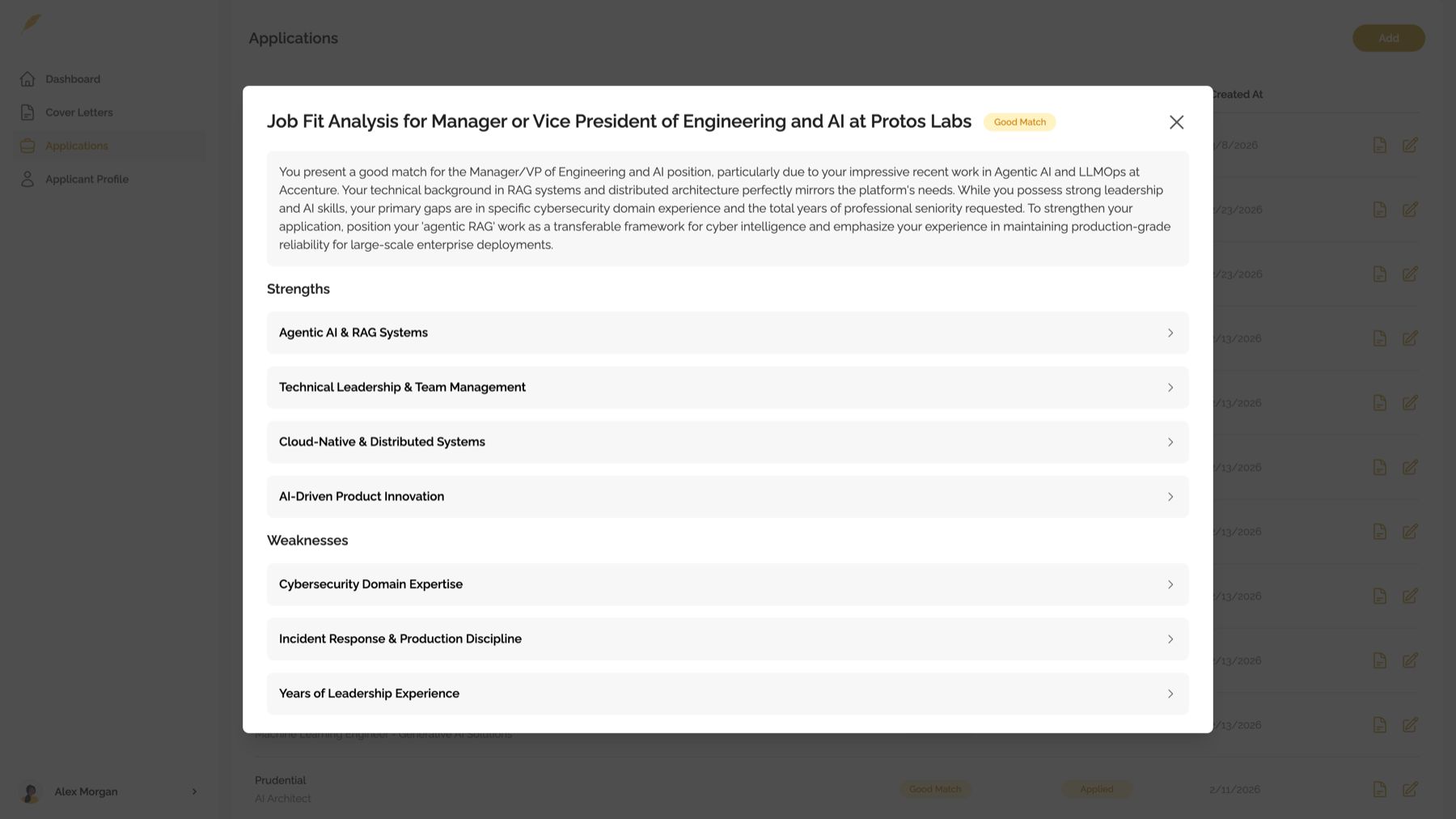
That does not mean the draft is automatically ready. You still need to verify claims, adjust voice, remove unsupported details, and decide what you are comfortable saying. Genwriter should help with structure and fit context, not replace your judgment.
If you upload or paste resume/profile information into any AI workflow, review what personal data is necessary and check the product's privacy policy before using it.
Start with structured inputs, not a blank chat
Genwriter helps you use your resume or profile and the job ad together, so the draft starts from fit context instead of generic cover-letter patterns.
Generate a tailored cover letter from your resume and the job ad
Final Checklist: Is Your ChatGPT Cover Letter Still Generic?
Use this checklist before sending. If any item fails, revise the draft or rebuild it from better inputs.
For the full pre-send workflow, use the final AI cover letter checklist.
FAQ
Why does my ChatGPT cover letter sound generic?
Usually because ChatGPT has not been given enough specific applicant evidence, prioritized job-ad requirements, or claim constraints. When those inputs are missing, it fills the space with common cover-letter patterns: broad enthusiasm, soft-skill claims, company praise, and "my experience aligns" language. That is why ChatGPT cover letters sound generic even when the grammar is fine. The fix is to match your real evidence to the job ad before asking for prose.
Is ChatGPT bad at writing cover letters?
Not automatically. ChatGPT can help draft useful cover-letter material when the source inputs are specific, truthful, and tied to the job. It can also produce generic or overstated drafts when asked to write too early. Treat it as a drafting assistant, not the decision-maker. You still need to decide which requirements matter, which evidence supports them, and which claims should be removed.
Why does ChatGPT keep using the same cover-letter phrases?
It is often responding to broad professional-writing instructions. If you ask for a polished cover letter without specific evidence or voice constraints, repeated phrases become the safe default. The same thing happens when the job ad is pasted without priority. Ask ChatGPT to diagnose the draft first: identify generic lines, map evidence to job priorities, and list phrases to avoid before rewriting.
Can I just ask ChatGPT to make my cover letter sound less generic?
You can, but that usually fixes surface wording more than the real problem. A generic sentence rewritten in smoother language can still be generic. A better instruction is: "Identify every unsupported or interchangeable line, match each job priority to evidence from my profile, and rewrite only using supported facts." That changes the source of the draft, not just the style.
Should I use ChatGPT for cover letters at all?
You can use ChatGPT responsibly if you supply truthful inputs, review the output, edit the voice, and verify every claim before sending. Do not auto-send an unreviewed AI draft. Do not invent tools, metrics, credentials, company research, motivations, years of experience, or domain expertise. The safest use is drafting and revision after you have already selected the evidence.
Can employers tell if my cover letter was written by ChatGPT?
There is no universal answer. Some employers may notice generic phrasing, weak fit, copied job-ad wording, or unsupported claims. Others may not focus on AI use at all. A 2023 ResumeBuilder.com survey found many hiring managers could not reliably identify ChatGPT-written cover-letter introductions, but that older survey should not be treated as a rule for every employer or market (ResumeBuilder.com). The practical fix is specificity and review, not detector evasion.
What should I give ChatGPT before asking for a cover letter?
Give it relevant resume or profile facts, the job description, 2-3 priority job requirements, evidence for each priority, tone constraints, and claims to avoid. Include project details, tools, workflows, stakeholder groups, customer context, scope, and true outcomes where available. Also tell it what not to invent: metrics, certifications, company facts, hiring-manager names, motivations, or experience you do not have.
How does Genwriter help avoid generic ChatGPT cover letters?
Genwriter helps keep your applicant profile and the job ad in the same workflow, then uses fit context to support a tailored draft. That can reduce the blank-chat problem where you re-explain your background from scratch for every application. You still need to review the final letter for truthfulness, voice, unsupported claims, and privacy-sensitive information. To start from structured inputs, generate a tailored cover letter from your resume and the job ad.
Make ChatGPT Useful By Giving It Better Signals
ChatGPT cover letters sound generic when the workflow skips source facts, job-ad prioritization, and evidence selection. The fix is not prettier generic prose. The fix is better signal.
Start by identifying the job priorities. Match those priorities to real applicant evidence. Flag gaps before drafting. Give ChatGPT constraints about what not to claim. Then audit every sentence before sending.
That process works whether you draft manually, use ChatGPT, or use Genwriter. If you want a structured workflow instead of starting from a blank chat each time, generate a tailored cover letter from your resume and the job ad, then review the result with the same evidence and claim-safety standards.